

Call today! 813.949.3300

Proudly Serving Lutz · Carrollwood · Northdale · Cheval · Odessa · Land O’ Lakes
Neuromodulators · Lutz, Florida

Crow’s Feet Treatment in Lutz, FL
Units, Cost & What Works

The lines that fan from the corners of your eyes come in two kinds, and only one of them answers to Botox®. Knowing which you have is the whole treatment plan — and it is the first thing Susan Wallace, MSN, ANP-BC, a Diamond-status Master Injector with 20+ years in aesthetics, works out at your consultation.
Top 4% Diamond injector
20+ Years of experience
4.7★ 67 Google reviews
On This Page

How Crow’s Feet Are Treated in Lutz, FL

Crow’s feet treatment in Lutz, FL begins with one question: Do your lines appear only when you smile, or do they stay when your face is at rest? Dynamic lines soften with Botox® or Dysport®. Static lines need resurfacing or skincare working alongside them. Susan Wallace, MSN, ANP-BC — a Diamond-status Master Injector with 20+ years in aesthetics — makes that call at Nu Image Medspa, 3939 Cheval Blvd, just off N Dale Mabry Hwy near Cheval, Steinbrenner High and Gaither High.

Most crow’s feet treatments use 12–24 units of Botox® in total, roughly 6–12 per side, or 30–60 units of Dysport®. A typical visit runs about $150–$400. Results begin in 3–5 days, peak at two weeks and last 3–4 months, with no downtime — the appointment itself takes about 10 minutes. Serving Lutz, Cheval, Carrollwood, Northdale, Odessa and Land O’ Lakes. Open Mon 9–5, Tue–Fri 9–7 and Sat 9–3. Call 813.949.3300.

The Sunglasses Problem

Why Lutz Finds Its Crow’s Feet Late

Sunglasses are on for most of the daylight hours here. The westbound afternoon run down the Veterans Expressway, the walk from the parking lot, the boat ramp, two hours on the sideline at Steinbrenner High or Gaither High — they go on in the driveway and come off at the door.

That does something quietly unhelpful. Sunglasses cover the outer corners of the eyes in almost every reflection you catch of yourself outdoors, and in most photos anyone takes of you. What they do not do is stop the squinting. Even behind a good pair you narrow your eyes against the glare coming off the water, off a windshield, off pale pavement. The muscle keeps contracting. You just stop watching it happen.

The indoor photo

So the discovery almost always happens inside. A gala at Cheval, a work headshot, a school picture day, someone’s wedding — flat indoor light, no sunglasses, and a version of your face you have not really looked at in a while. Clients tell us the same thing in the consult room, some variation of: I did not think they were that deep.

Why the delay changes the treatment

Because of that lag, people in the Tampa area often arrive at a first consultation later in the process than they realize. Lines that once appeared only with a smile have started to hold their shape at rest. That matters, because the two behave completely differently, and a plan built for one will disappoint on the other.

The Distinction That Decides Everything

Dynamic Lines, Static Lines, and Why It Matters

Look in a mirror with your face completely relaxed. Then smile properly — the kind that reaches your eyes.

The lines that appear only in the second half of that test are dynamic. They are made by the orbicularis oculi, the ring of muscle around the eye that contracts every time you smile or squint. Relax that muscle with Botox® or Dysport® and the skin above it stops folding. This is the job neuromodulators are built for, and it is the reason results here look like a rested version of you rather than a changed one.

The lines still visible in the first half are static. Those are creases in the skin itself, from years of folding plus collagen loss and sun damage. Relaxing the muscle underneath softens them a little, but it cannot iron out a crease that is already set. They need something that works on the skin: resurfacing, collagen stimulation, and daily sun protection.

Most people past their early forties have both, in the same fan of lines. That is the honest answer to a common frustration — someone has Botox®, the movement stops, and a few faint lines remain at rest. Nothing went wrong. Those particular lines were never going to respond to a neuromodulator alone.
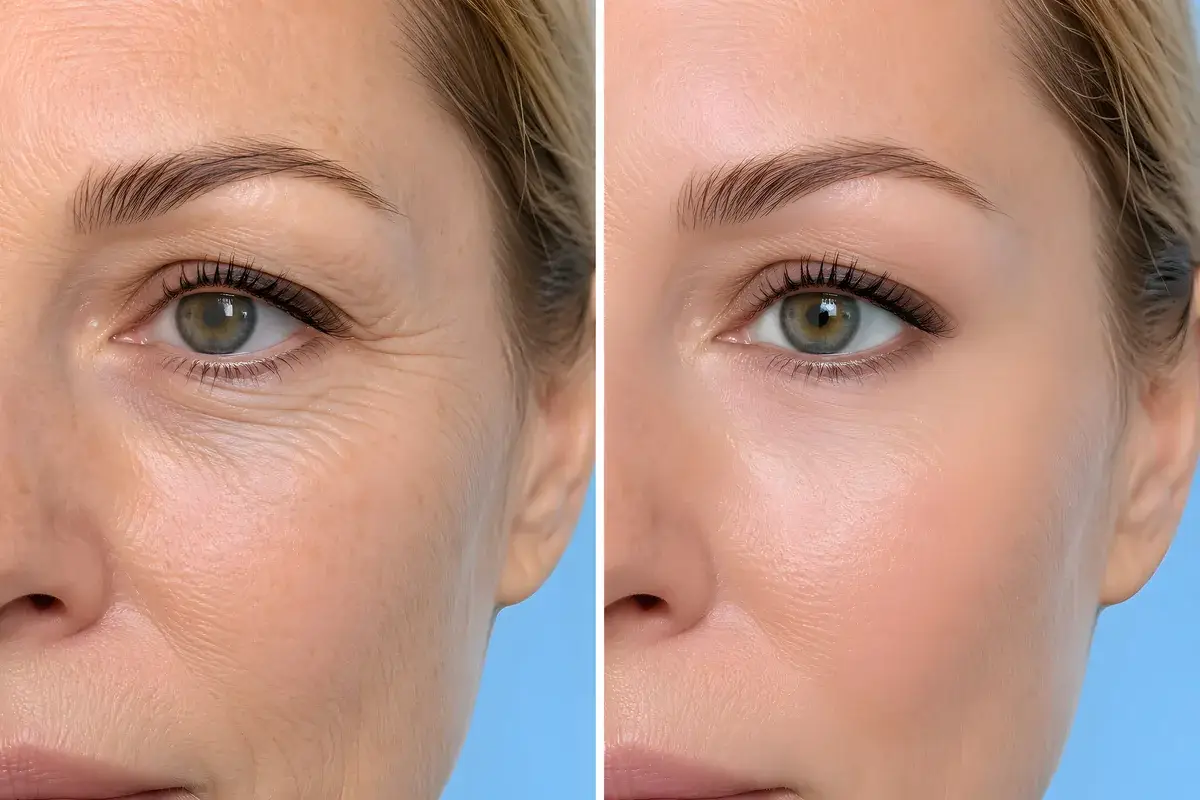
Illustration comparing crow's feet at rest with a smoother eye area after treatment
Illustration only. This is a computer-generated simulation created to show the difference between lines that hold at rest and a softened eye area. It is not a Nu Image Medspa client, and individual results vary.
Side by Side

Which Kind Do You Have?

The mirror test gets you most of the way there. The rest is knowing what each type actually responds to — and being told plainly when an injectable is not the right tool for part of the job.

DynamicStatic
When you see themOnly when you smile or squintAlso at rest
CauseMuscle contractionCollagen loss, sun damage
Responds to toxYesOnly partly
What works12–24 unitsResurfacing, SPF
Timeline3–5 daysWeeks to months
Past your 40sUsually both, and both need addressing
Real Numbers

How Many Units Crow’s Feet Actually Take

Most crow’s feet treatments use 12–24 units of Botox® in total, which works out to roughly 6–12 units per side, placed across three or four points in the fan lateral to each eye. Allergan’s own on-label figure for this area is 24 units total, so a quote of 10 units for both sides together is a light dose that tends to fade early.

With Dysport® the number looks bigger because the units are not equivalent. The conversion runs at roughly two and a half to one, so the same correction usually lands between 30 and 60 units. Neither product is stronger. The scales are simply different, which is worth knowing before comparing two quotes side by side. Our Botox® vs Dysport® comparison walks through the rest.

What moves the number

Four things, mostly. How strong the orbicularis is, which varies enormously between people. How deep the lines already are. How much of the fan gets treated, since some people want only the upper lines softened and their lower ones left alone. And whether the crease just under the lower lash line is included, which asks for one or two extra units placed very precisely.

Your exact number is settled at the consultation, after watching your face move. It is not read off a chart, and it is confirmed with you before anything is injected.

At a Glance

Crow’s Feet at a Glance

Best for Lines fanning from the outer corners of the eyes, whether visible on smiling or at rest
How it’s done Botox® or Dysport® into the lateral orbicularis oculi, with resurfacing added when lines hold at rest
Typical units 12–24 units Botox® total (6–12 per side) · 30–60 units Dysport®
Typical cost (Lutz) About $150–$400 per visit · priced per unit · see monthly specials
Results appear 3–5 days · full effect at about 2 weeks
Results last 3–4 months · often the shorter end, as this muscle is thin and constantly active
Downtime None — about 10 minutes, then back to your day
Performed by Susan Wallace, MSN, ANP-BC · Diamond-status Master Injector · 20+ years

Pricing is approximate and confirmed at your complimentary consultation. Ask about current specials and flexible payment plans.

How We Treat the Area

Ways We Tailor the Treatment

Every plan is mapped to how your face actually moves. Common approaches include:

The lateral fan

The main event: Three or four points beside each eye, softening the lines that spread toward the temple while your smile stays entirely your own.

~6–12 units per side

The lower lash crease

The fold that appears just under the lower lashes when you smile. A very small dose, placed precisely, because this spot is unforgiving.

~1–2 units per side

Crow’s feet with a brow tail lift

Relaxing the outer eye muscle also releases its downward pull on the brow. A few extra units turn that into a visible lift.

Pairs with brow lift →

Preventative dosing

For the late 20s and 30s: Lighter dosing that keeps a dynamic line from wearing itself into a permanent one.

Resurfacing for static lines

For creases that hold at rest, treating the skin itself rebuilds collagen where a neuromodulator cannot reach.

Skincare and daily SPF

The least glamorous part and the one that decides the next decade. Sun exposure here is what turns dynamic lines static.

Not sure whether your lines are dynamic, static or both? The mirror test gets you close. A consultation settles it, with your units and price confirmed up front.

The Honest Version

When Botox® Isn’t the Answer

Plenty of people arrive expecting an injectable and leave with something else, or with a plan where the injectable is only part of it. That is a better outcome than a treatment that was never going to work on the lines bothering them.

When the lines hold at rest

Static creases need the skin rebuilt rather than the muscle relaxed. Fraxel® resurfacing and microneedling both drive new collagen into the area over a series of sessions. Chemical peels and IPL address the surface texture and the sun damage sitting alongside the lines. None of these replaces Botox®. They run alongside it, and that pairing is what finally shifts an eye area that has not responded to tox on its own.

Why filler is usually the wrong tool here

People ask about it often, and the answer is almost always no, at least not directly into the crow’s feet. The skin at the outer eye is among the thinnest anywhere on the body. Hyaluronic acid placed into that plane has a real tendency to sit visibly, and it can throw a faint bluish cast under thin skin. There is a useful exception: Volume loss at the temple or the upper cheek changes how the whole area sits, and restoring support there with dermal fillers can soften the fan indirectly. That is a structural decision made about the surrounding face, not an injection into the lines.

What actually prevents them

Sunscreen every day, sunglasses that genuinely block UV, and a retinoid used consistently. None of it is exciting, and all of it outperforms anything else at keeping a dynamic line from becoming a permanent one. In a market this bright, it is the highest-return habit available.

Why the Injector Matters Here

The Smile Is Two Millimeters Away

The muscle that creates crow’s feet runs right alongside the muscle that lifts the corner of your mouth. Place a unit slightly too low, or a little too far toward the cheek, and some of the product reaches the zygomaticus major. The result is a smile that pulls unevenly — visible in every photograph for three months, with no way to reverse it. Unlike filler, a neuromodulator cannot be dissolved. You wait it out.

Care alone does not prevent that. What prevents it is knowing where your face recruits muscle before the first injection goes in, and reading which of your lines will respond at all. That kind of reading only comes from volume — 20+ years in aesthetics, thousands of treatments around the eye, and enough follow-up visits to know how each one settled. It is what Susan’s Diamond-status Master Injector designation measures, and it is why a fair number of the injectors now working across Tampa Bay learned this part of the face from her.

◆ Diamond-Status Master Injector
20+ Years in Aesthetics
✓ ANCC Board-Certified NP
4.7★ 67 Reviews
What to Expect

Your Visit, Step by Step

1
Consultation

We watch how your face moves, sort dynamic lines from static ones, and agree your units and price before anything else.

2
Treatment

Three or four quick injections per side. About 10 minutes, and most people describe it as a pinch.

3
Right back to it

No downtime. Skip heat, hard exercise and rubbing the area for the rest of the day.

4
Results & review

Softening starts at 3–5 days and peaks around two weeks, with an optional review to fine-tune.

Getting Here

Minutes from Across North Tampa

We’re centrally located on Cheval Blvd, an easy drive from across the area. Tap your neighborhood for directions and local details.

Drive times are approximate — check live directions for your exact route. Free on-site parking at 3939 Cheval Blvd, Lutz, FL 33558.

What our clients say

This was my first visit and it was a fantastic experience. Jenny is knowledgeable, friendly and meticulous in everything she does. I LOVE my new lips — thank you for making me look and feel more beautiful!

— C. Seyss

I’ve been going to Susan for 8 years and she and her staff are the best. She’s patient and takes her time to make perfection — I call her “Picasso.” Great prices, too.

— R. Dalom

Simply the best! I’ve been coming to this salon since 2007. From haircuts and facials to Botox, it’s nothing but the best experience and value. I always leave looking and feeling amazing.

— B. Gibson

Crow’s Feet Treatment in Lutz, FL — FAQ

Most treatments use 12–24 units in total, roughly 6–12 per side, placed across three or four points beside each eye. Allergan’s on-label figure for this area is 24 units total, so a quote of 10 units for both sides is a light dose that often fades early. Your exact number depends on muscle strength, line depth and how much of the fan you want treated.

A crow’s feet visit at Nu Image Medspa typically runs about $150–$400, priced per unit rather than per area. Your exact figure is confirmed at your complimentary consultation before anything is injected, and we run new specials every month.

For most people, yes. Twenty units splits to 10 per side, which sits comfortably inside the usual range and close to the on-label figure of 24. Someone with a strong orbicularis or deeper lines may need the upper end, while a lighter preventative dose may sit below it.

Two things at once. The orbicularis oculi contracts every time you smile or squint, folding the skin above it. Over years, collagen and elastin decline and sun exposure breaks down the skin’s structure, so those folds stop bouncing back. In Florida the second half moves faster, which is why the lines tend to appear earlier here than in cloudier places.

Into the lateral orbicularis oculi — three or four points arranged in the fan beside each eye, roughly a centimeter out from the bony orbital rim. Placement stays deliberately clear of the muscles that lift the corner of the mouth, since product reaching those flattens the smile on that side.

For lines that hold at rest, treating the skin works better than treating the muscle. Fraxel® resurfacing and microneedling stimulate new collagen over a series of sessions, and chemical peels improve surface texture. Daily sunscreen and a consistent retinoid do more than any product to stop new lines forming. For lines that only appear when you smile, though, a neuromodulator is the only thing that addresses the cause.

Usually 30–60 units. Dysport® units are not equivalent to Botox® units — the conversion runs at roughly two and a half to one — so a higher number does not mean a stronger treatment. Our Botox® vs Dysport® comparison covers how the two differ in onset and spread.

Generally not directly into them. The skin at the outer eye is among the thinnest on the body, so hyaluronic acid placed there can sit visibly and cast a faint bluish tone. The exception is structural: When volume loss at the temple or upper cheek is changing how the area sits, restoring support with dermal fillers can soften the fan indirectly.

Typically 3–4 months, often nearer three. The orbicularis oculi is thin and in near-constant use, so results here tend to fade a little sooner than they do on the forehead. Most clients settle into treating this area every three to four months.

We’re at 3939 Cheval Blvd, Lutz, FL 33558, just off N Dale Mabry Hwy near Cheval, Steinbrenner High School and Gaither High School — serving Lutz, Carrollwood, Northdale, Cheval, Odessa and Land O’ Lakes. Open Mon 9–5, Tue–Fri 9–7 and Sat 9–3, with free on-site parking. Call 813.949.3300 to book.