

Call today! 813.949.3300
Frown lines treatment in Lutz, FL targets the two vertical lines between the eyebrows — the “11s,” known clinically as glabellar lines. They are made by the corrugator and procerus muscles, which pull the brows inward and down every time you concentrate, read something difficult or squint into bright light. Susan Wallace, MSN, ANP-BC — a Diamond-status Master Injector with 20+ years in aesthetics — treats them at Nu Image Medspa, 3939 Cheval Blvd, just off N Dale Mabry Hwy near Cheval, Steinbrenner High and Gaither High.
This is the one facial area with a published FDA dose. Botox® is on-label at 20 units across five injection points; Dysport® at 50 units across five points — a larger number for the same correction, because the two unit scales are not equivalent. A typical visit runs $200–$450. Results begin in 3–5 days, peak at two weeks and last 3–4 months, with no downtime. Serving Lutz, Cheval, Carrollwood, Northdale, Odessa and Land O’ Lakes. Open Mon 9–5, Tue–Fri 9–7 and Sat 9–3. Call 813.949.3300.
Frown lines, 11s, glabellar lines, worry lines — four labels for the same thing. They are the vertical creases that form between the eyebrows, in the patch of skin called the glabella, and they run roughly parallel, which is where the nickname comes from.
Two muscles make them. The corrugator supercilii sits under each inner brow and pulls it toward the middle of your face, which is what draws the skin into a vertical fold. The procerus runs down the bridge of the nose and pulls the whole area downward, adding the horizontal crease that often appears with them.
Both are small, both are strong, and both fire constantly without any conscious involvement. That combination is why this particular pair of lines tends to etch in earlier and more deeply than forehead lines or crow’s feet. A shallow fold made a thousand times a day becomes a sharp one.
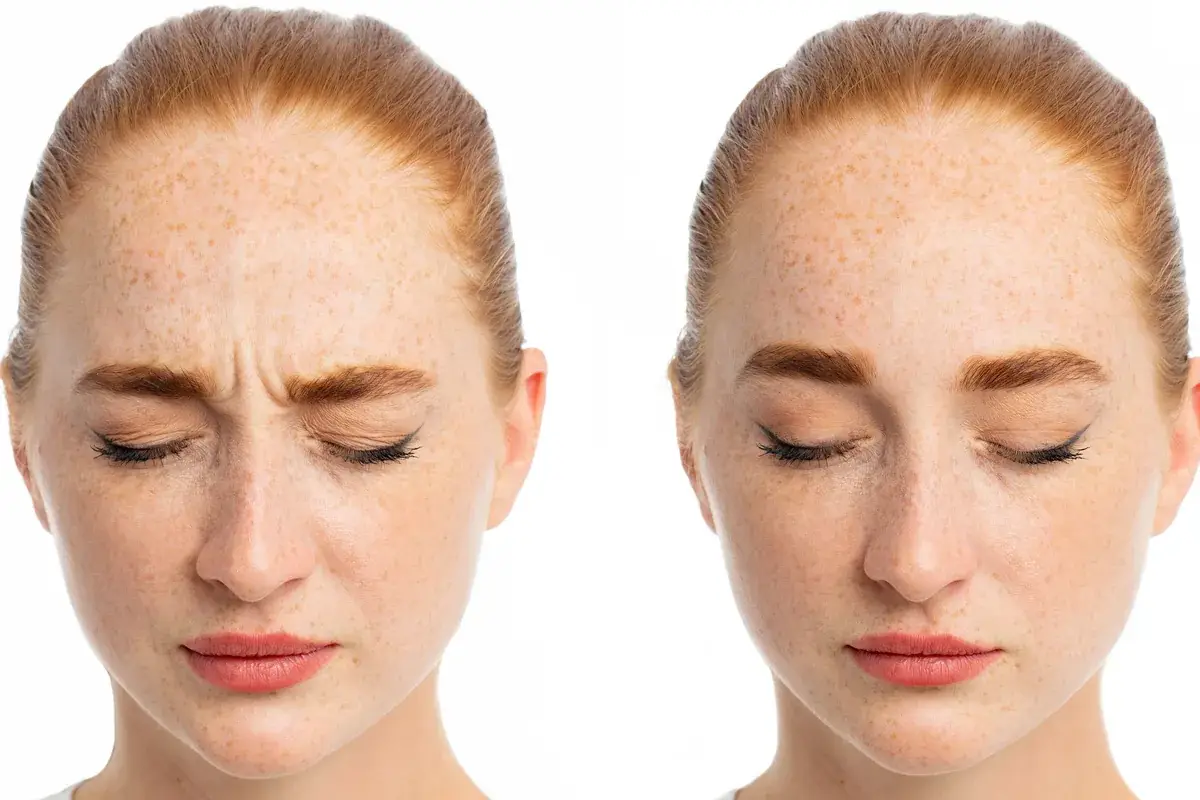
Crow’s feet get read as warmth. People see them and think you laugh a lot. The 11s get read as something else entirely — irritation, disapproval, worry — and they get read that way by other people, on a face that feels perfectly neutral from the inside.
That is why the complaint that brings someone into this consultation is rarely about looking older. It is closer to: My team keeps asking if something is wrong. I got feedback that I come across as closed off. My daughter asked why I was angry at her.
The corrugator answers to two completely unrelated things. Bright light is the first, and around here that runs year-round — the walk across a parking lot, the drive west on the Veterans Expressway at five o’clock, an afternoon on the water. Concentration is the second: a spreadsheet, a difficult email, a screen at slightly the wrong distance. Most people get the first for free and the second at work, which is a lot of contractions in a day.
Tampa Bay runs on face-to-face work. Hospitality, healthcare, real estate, teaching, sales, and a convention and tourism layer that puts people in front of strangers all day. In work like that, a resting expression that reads as displeasure is a practical problem well before it is a cosmetic one — which is also why these are the lines people try hardest to cover with makeup, and the only ones they routinely ask how to hide.
Most of the face is treated on judgment and experience. The glabella is different: It carries an FDA on-label dose, established in the trials that got these products approved.
For Botox® that is 20 units, divided across five injection points — one in the procerus between the brows, and two into each corrugator. For Dysport® it is 50 units across the same five points. The gap between 20 and 50 is not a difference in strength. The two products are measured on different scales, at roughly two and a half Dysport® units to one of Botox®, so the correction is equivalent. Our Botox® vs Dysport® comparison covers how else they differ.
This matters when you are comparing quotes. A plan that starts at 10 units for this area sits below the studied dose, and tends to wear off well inside the usual three to four months.
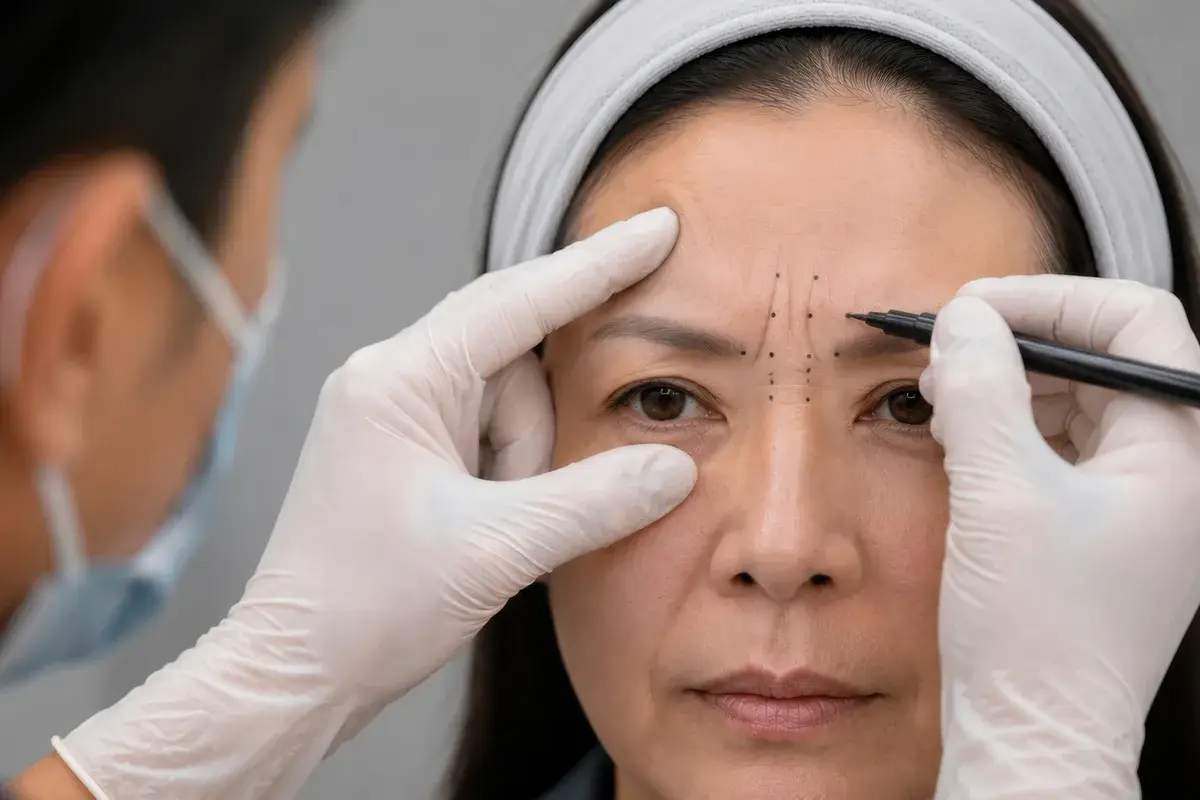
Corrugator strength varies enormously, and a strong one can need more than the on-label figure to hold for a full cycle. Depth matters too — a line already set into the skin behaves differently from one that only appears on movement. And the forehead has a vote: If your frontalis is working hard to hold the brows up against a strong glabellar pull, treating one area without accounting for the other changes where your brows sit.
Both products treat this area in the identical pattern, and both are FDA-approved for it. The unit counts look wildly different because the scales are different, not the strength. Which one suits you comes down to onset and how much spread your anatomy wants.
| Botox® | Dysport® | |
|---|---|---|
| On-label dose | 20 units | 50 units |
| Injection points | Five, same pattern | |
| Why they differ | Unit scales, roughly 2.5:1 | |
| Onset | 3–5 days | 2–3 days |
| Spread | Tighter | Wider |
| Lasts | 3–4 months | |
Relax the muscle and the movement stops. If the crease is still visible with your face completely still, that part of it is no longer being made by muscle — it is a fold in the skin itself, and it needs something that works on skin.
The 11s reach that stage sooner than most lines. The fold here is sharp rather than broad, so it concentrates the creasing into a narrow band and wears a groove faster. Plenty of people arrive in their forties with lines that are already partly set.
The realistic plan is both at once. The neuromodulator stops the fold being reinforced, and Fraxel® resurfacing or microneedling rebuilds collagen in the crease over a series of sessions. Expect real softening rather than erasure, and expect it to take months rather than days.
A small amount of hyaluronic acid can be placed into a deep, set 11 to lift the floor of the crease, and in the right hands it works. It also needs saying plainly: The glabella is the highest-risk site on the face for filler. The blood supply here connects to vessels feeding the eye, and an occlusion at this spot is the rare complication that can threaten vision. That risk is why many injectors decline filler here entirely, why it should never be a casual add-on, and why anyone offering it should be able to tell you exactly how they mitigate it before you agree.
Partly, and more than with most lines — because unlike sun damage, a good share of this one is a habit.
This is the least glamorous item on the list and probably the most effective. An out-of-date prescription, an uncorrected astigmatism or a screen at slightly the wrong distance produces hours of low-grade corrugating every day, and almost nobody notices they are doing it. People who fix their vision often report the tension between their brows easing before anything else changes.
Awareness genuinely helps, because this muscle fires unconsciously. Many people find that simply catching themselves — on a video call, in a car mirror — is enough to cut the frequency down. Sunglasses handle the light half of the trigger. Sleeping face-down into a pillow adds mechanical folding on top of everything else, so side or back is kinder.
For people in their late 20s and 30s whose 11s appear only on movement, lighter-than-standard dosing keeps the fold from being reinforced while the skin still recovers fully between contractions. The aim is not to freeze a young face, it is to stop a dynamic line becoming a permanent one. Preventative Botox® covers the wider approach.
| Also called | 11s, glabellar lines, worry lines |
|---|---|
| Muscles treated | Corrugator supercilii and procerus |
| How it’s done | Botox® or Dysport® across five points between and above the brows |
| On-label dose | Botox® 20 units · Dysport® 50 units |
| Typical cost (Lutz) | About $200–$450 per visit · priced per unit · see monthly specials |
| Results appear | 3–5 days · full effect at about 2 weeks |
| Results last | 3–4 months |
| Downtime | None — about 10 minutes, then back to your day |
| Performed by | Susan Wallace, MSN, ANP-BC · Diamond-status Master Injector · 20+ years |
Pricing is approximate and confirmed at your complimentary consultation. Ask about current specials and flexible payment plans.
Every plan is built around how strongly your glabella actually pulls. Common approaches include:
Five points, one in the procerus and two into each corrugator — the arrangement the FDA trials used, and the right starting place for most people.
20 units Botox®
Dense, powerful muscle needs more than the on-label figure to hold a full cycle. Common in men and in anyone whose 11s came in early.
Above standard dosing
These two areas are linked. Treat the glabella alone and the forehead can overwork; treat the forehead alone and the brows can settle lower.
Releasing the inward-and-down pull frees the inner brow. Pairing it with the outer brow gives a balanced lift instead of a lopsided one.
Late 20s and 30s, lines only on movement: Lighter dosing that stops the fold being reinforced before it sets.
When the crease holds at rest, rebuilding collagen in the skin is what reaches the part a neuromodulator cannot.
Not sure whether your 11s need the standard dose, more, or something alongside it? A consultation settles it, with your units and price confirmed up front.
Directly beneath the glabellar complex sits the levator palpebrae superioris — the muscle that holds your upper eyelid open. Product placed too deep, too low, or too close to the bony rim can diffuse onto it. The result is eyelid ptosis: A visibly drooping lid, on one side, for several weeks. It is the Botox® complication people have actually heard of, and the reason many first-timers are nervous about this specific area.
It is also almost entirely a technique problem, and a small one: a set margin above the bony rim, the corrugator injected at its own plane rather than deeper into it, and the dose chosen after reading how hard the forehead is already working to hold the brows up. None of that is difficult to describe. Doing it consistently on faces built differently from one another is the part that takes time.
Susan is an ANCC board-certified Adult Nurse Practitioner who has been injecting since 2004, holds Diamond-status Master Injector designation, and teaches technique to other injectors across Tampa Bay. On an area where the margin for error is measured in millimeters of depth, that background is the whole difference.
We watch the glabella move, check how hard your forehead is compensating, and agree your dose and price first.
Five small injections across the area. Under 10 minutes, and most people describe it as a pinch.
No downtime. Stay upright a few hours, and skip heat, hard exercise and rubbing the area that day.
Softening starts at 3–5 days and peaks around two weeks, with an optional review to fine-tune.
We’re centrally located on Cheval Blvd, an easy drive from across the area. Tap your neighborhood for directions and local details.
Cheval Frown Lines →
Northdale Frown Lines →
Odessa Frown Lines →
Carrollwood Frown Lines →
Land O’ Lakes Frown Lines →
Drive times are approximate — check live directions for your exact route. Free on-site parking at 3939 Cheval Blvd, Lutz, FL 33558.
This was my first visit and it was a fantastic experience. Jenny is knowledgeable, friendly and meticulous in everything she does. I LOVE my new lips — thank you for making me look and feel more beautiful!
— C. Seyss
I’ve been going to Susan for 8 years and she and her staff are the best. She’s patient and takes her time to make perfection — I call her “Picasso.” Great prices, too.
— R. Dalom
Simply the best! I’ve been coming to this salon since 2007. From haircuts and facials to Botox, it’s nothing but the best experience and value. I always leave looking and feeling amazing.
— B. Gibson
The FDA on-label dose for the glabellar area is 20 units, divided across five injection points — one in the procerus between the brows and two into each corrugator. Strong or dense muscle can need more to hold a full three-to-four-month cycle. A plan starting at 10 units for this area sits below the studied dose and often wears off early.
A frown line visit at Nu Image Medspa typically runs about $200–$450, priced per unit rather than per area. Your exact figure is confirmed at your complimentary consultation before anything is injected, and we run new specials every month.
Frown lines are the two vertical creases between the eyebrows, also called the 11s, glabellar lines or worry lines. They form in the patch of skin called the glabella and are made by the corrugator supercilii and procerus muscles, which pull the brows inward and down.
Frown lines are caused by repeated contraction of the corrugator and procerus muscles between the eyebrows. Every time you concentrate, squint or frown, these muscles pull the brows together and fold the skin vertically. Over years, that folding combines with declining collagen and sun damage, and the crease stops recovering between contractions.
The on-label dose is 50 units across the same five points. That is higher than the 20 units of Botox® used for the identical correction because the two products are measured on different scales, at roughly two and a half to one. Neither is stronger. See our Botox® vs Dysport® comparison.
It can, though it is uncommon. The muscle that holds the upper eyelid open sits just beneath this area, and product placed too deep or too close to the bony rim can diffuse onto it, causing the lid to droop on that side. It is temporary and resolves as the product wears off, but it can last several weeks. Careful depth and distance from the orbital rim are what prevent it, which is why this area rewards an experienced injector more than almost any other.
Start with your eyes. An out-of-date prescription, uncorrected astigmatism or a badly positioned screen produces hours of unconscious frowning a day, and correcting it often eases the tension on its own. Add sunglasses for the glare half of the trigger, sleep on your side or back rather than face-down, and catch yourself doing it on video calls. For lines that appear only on movement, lighter preventative dosing keeps the fold from being reinforced while the skin still recovers fully.
A line still visible with your face completely still is a fold in the skin rather than a muscle contraction, so a neuromodulator alone will not remove it. The realistic plan runs both together: Botox® or Dysport® to stop the fold being reinforced, plus Fraxel® resurfacing or microneedling to rebuild collagen in the crease over a series of sessions. Expect substantial softening over months rather than erasure.
Sometimes, and it needs a direct caution. A small amount of hyaluronic acid can lift the floor of a deep, set crease, but the glabella is the highest-risk site on the face for filler: Its blood supply connects to vessels feeding the eye, and a vascular occlusion here is the rare complication that can threaten vision. Many injectors decline filler in this area for that reason. If it is offered to you, ask exactly how the risk is managed before agreeing. See dermal fillers for areas where it is the straightforward choice.
We’re at 3939 Cheval Blvd, Lutz, FL 33558, just off N Dale Mabry Hwy near Cheval, Steinbrenner High School and Gaither High School — serving Lutz, Carrollwood, Northdale, Cheval, Odessa and Land O’ Lakes. Open Mon 9–5, Tue–Fri 9–7 and Sat 9–3, with free on-site parking. Call 813.949.3300 to book.